
The Myth of Career Security
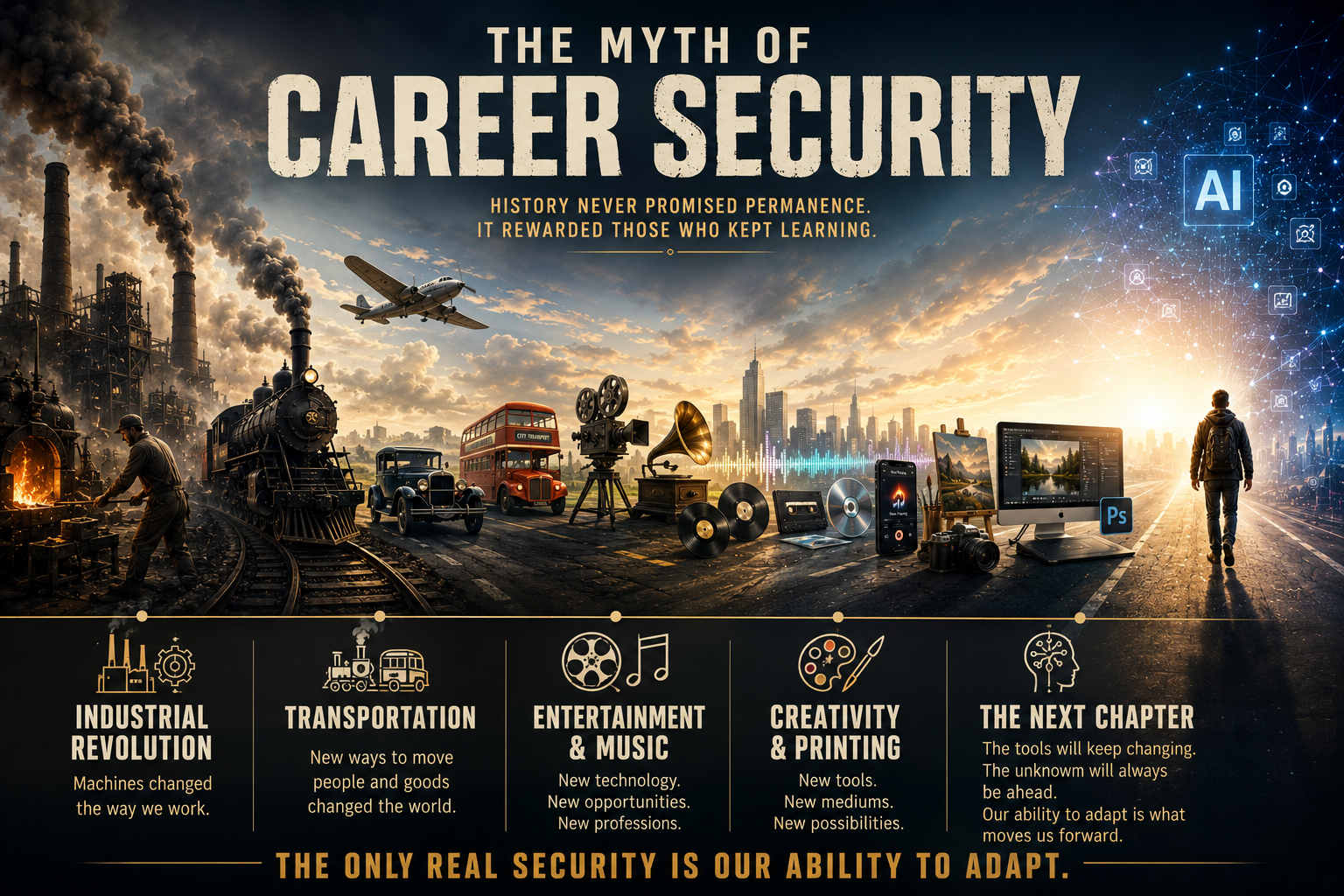
The Myth of Career Security
Every generation eventually reaches the same uncomfortable moment.
Something changes. Not a little. A lot.
Enough to make people wonder whether everything they’ve worked for is about to disappear.
Today, that conversation is about artificial intelligence.
Yesterday, it was something else.
And that’s why I think we need to pause—not to stop progress, but to stop believing our moment is somehow unique. We need to zoom out and observe what was left behind in history.
Maybe we need to reach a quiet agreement with ourselves before we can have an honest conversation.
An agreement that history has never really offered career security.
Only the opportunity to learn, adapt, and keep moving.
Take a step back.
Not ten years. Not fifty. A century. Maybe two. History doesn’t repeat itself perfectly.
But it certainly likes to rhyme.
Let’s begin with the Industrial Revolution.
Machines arrived. Factories expanded. Entire ways of working began to change.
Many people believed they were witnessing the end of meaningful work.
Can we really blame them?
If a machine suddenly performed your life’s work faster, cheaper, and more efficiently, fear wasn’t irrational.
It was human. Some jobs disappeared. Many others hadn’t even been imagined.
Looking back today, we see engineers, electricians, mechanics, technicians, factory managers, designers, and industries that simply didn’t exist before.
The people living through that transition couldn’t see what was coming.They only saw what was disappearing.
Then transportation transformed the world.
For centuries, people and goods moved at the pace that animals allowed.
Distance shaped businesses. Distance shaped families. Distance shaped opportunity itself.
Then railways connected regions. Automobiles transformed personal travel. Buses reshaped growing cities.
Trucks revolutionized commerce. Aviation connected continents.
Every innovation made older ways less dominant while creating opportunities that previous generations could never have imagined.
The same story unfolded in entertainment.
Silent films gave way to sound.
Imagine being one of the biggest stars of the silent era. You had finally achieved recognition. Financial security. A future that felt predictable.
Then audiences suddenly wanted something different.
Some careers faded. Others adapted.
Entirely new professions appeared.
Sound engineers. Recording studios. Dialogue writers. Voice coaches.
History remembers the evolution. The people living through it mostly remembered the uncertainty.
Music followed the same path. Records became cassettes. Cassettes became CDs. CDs became digital downloads. Downloads became streaming. Every transition was met with skepticism.
Every transition also created opportunities for musicians, producers, recording engineers, software developers, streaming platforms, digital distributors, and countless independent artists who suddenly had a global audience. The tools changed. The desire to create music never did.
Creativity tells a similar story.
Photography challenged painters. Digital cameras challenged traditional photography. Oh, Adobe Photoshop arrived. I still remember when many professionals dismissed it.
“It isn’t real.” “It will never replace traditional methods.” “It’s cheating.”
Today those conversations feel almost forgotten. Photoshop didn’t eliminate creativity. It simply became another instrument in the hands of creative people.
And now…
Artificial intelligence. The latest chapter.
Will it change the way we work? Almost certainly.
Will some professions disappear? History suggests yes.
Will entirely new professions appear? History suggests that too.
Perhaps the most interesting pattern is this.
Whenever change arrives, we instinctively count what might disappear.
We rarely spend the same energy imagining what might appear.
Maybe that’s because losses are immediate.
Opportunities usually reveal themselves quietly. Often years later.
If someone had predicted thirty years ago that people would build careers creating smartphone apps, producing podcasts, managing social media, editing YouTube videos, flying drones, designing virtual worlds, or collaborating daily with artificial intelligence, it would have sounded unrealistic.
Yet here we are.
None of those careers appeared because the world stood still. They appeared because it kept moving.
Maybe that’s the lesson history has been trying to teach us all along.
Career security has always been more comforting than real.
Adaptability has always been the better investment.
That doesn’t make change painless.
People lose jobs. Businesses disappear. Entire industries are reshaped.
Those stories deserve empathy, not dismissal.
But resisting reality has never stopped reality from arriving.
Like it or not, tomorrow keeps showing up. It always has.
The more I look back, the less convinced I become that artificial intelligence is the real story.
The real story is us.
Our tendency to believe that today’s world will somehow remain unchanged.
Our instinct to fear what we don’t yet understand.
And our remarkable ability—proven generation after generation—to learn, adapt, reinvent ourselves, and move forward.
Perhaps that’s the agreement we need to make with ourselves.
Not that every new technology is wonderful.
Not that every fear is irrational.
But that history has never guaranteed permanent career security.
What it has consistently rewarded is curiosity. Adaptability. Resilience.
And the courage to keep learning.
The future has never asked for permission before arriving.
This time won’t be any different.
